

-
economicmargins
-
 April 11, 2026
 -
 Global Economy
Chokepoints of Power: Why Narrow Waterways Control the Global Economy
With the rise of globalization since the 1980s, we assume that global trade flows smoothly across vast oceans, supported by advanced logistics and modern technology. But in reality, the global economy depends heavily on a few narrow and highly strategic waterways. These maritime “chokepoints” act less like open highways and more like critical bottlenecks through which an enormous share of the world’s trade must pass.
Despite their limited size, these routes carry a disproportionate volume of global food, fuel, and manufactured goods. Recent crises have made this dependence very clear. Events such as the blockage of the Suez Canal showed how a single disruption in one location can ripple across the entire global economy. What appears to be a seamless system is, in fact, surprisingly fragile.
Understanding Maritime Chokepoints
Maritime chokepoints are narrow strategic sea routes —either natural (strait) or man-made (canal) — through which a significant number of maritime traffic passes. According to the International Maritime Organization, maritime transport accounts for around 80–90% of global trade by volume. This makes maritime routes the backbone of international trade, and chokepoints the most sensitive parts of that system.
These routes significantly reduce both travel time and transportation costs. Instead of taking long and inefficient paths across open oceans, ships are funneled through shorter, more predictable routes. This allows shipping companies to operate on tight schedules and reduces fuel consumption. For example, without such routes, vessels would have to sail around entire continents, adding both time and expense.
At the same time, chokepoints enable modern logistics systems such as “just-in-time” delivery. Their reliability allows companies to minimize inventory and operate more efficiently. However, this efficiency comes with a trade-off: heavy dependence on a small number of routes that have very limited alternatives. Key chokepoints such as the Strait of Hormuz, Strait of Malacca, Panama Canal, and Bab el-Mandeb form the backbone of global trade. They are essential not just for moving goods, but also for transporting energy resources such as oil and natural gas.
Major Chokepoints and Their Strategic Importance
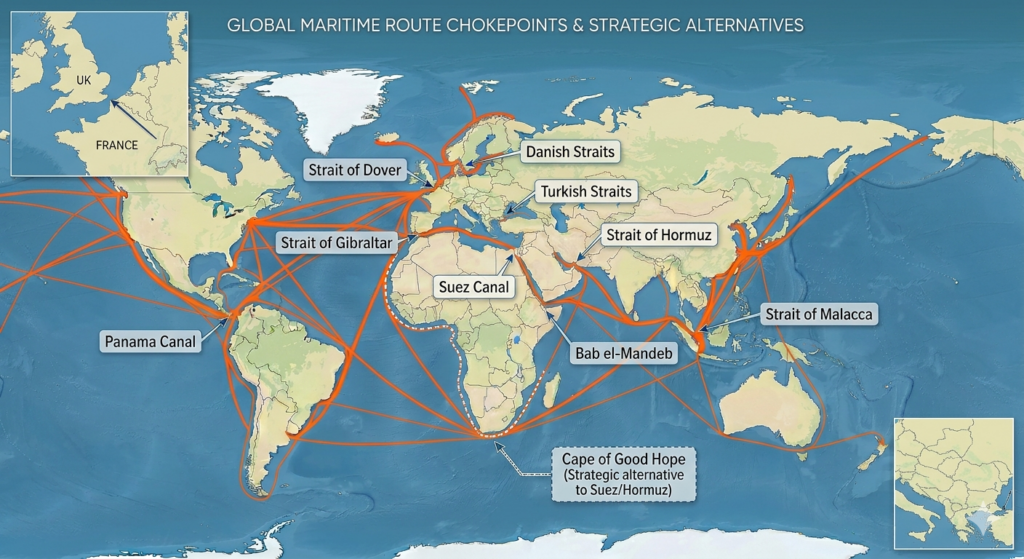
The Strait of Hormuz lies between Iran and Oman, is regarded as The Energy Valve, the most vital oil passage on Earth. One-fifth of the world’s oil and LNG flows through here. There is literally no other way to get oil out of the Persian Gulf by sea. Any disruption here has immediate repercussions for global oil prices and energy markets.
The Strait of Malacca, which lies between Malaysia, Indonesia & Singapore connecting the Indian Ocean with the Pacific Ocean. Known as, The Factory Gateway, carries 30% of all global trade and 80% of China’s energy imports.
The Suez Canal serves as a vital shortcut between Europe and Asia. Without this 120-mile ditch, ships must sail around the entire continent of Africa, adding 10–14 days to the trip. It handles around 10–15% of global trade, making it one of the most economically significant waterways in the world.
Bab el-Mandeb, which lies between Yemen & Djibouti, known as “The Guardian of the Suez”. One can’t get to the Suez Canal from Asia without passing this narrow strait. It is the “front door” to the Red Sea. About 6–12% of global oil trade passes through this route, making it highly sensitive to instability.
Panama Canal located in Panama is known as “The Americas Connector”, links the Atlantic and Pacific, saving ships a dangerous trip around the tip of South America. It is essential for U.S. trade and South American exports.
Turkish Straits located in Turkey (Bosporus/Dardanelles) is known as “The Black Sea Exit”. The only way for grain and oil from Russia, Ukraine, and Central Asia to reach the rest of the world.
Strait of Gibraltar situated between the southern tip of Spain and the northern coast of Morocco is known as “Light Switch” of the Mediterranean, is the only natural entrance and exit to the Mediterranean Sea from the Atlantic Ocean. Almost all goods entering southern Europe or North Africa via the Atlantic must pass through here, making it one of the world’s busiest shipping lanes.
Danish Straits connects the North Sea to the Baltic Sea is known as the “Energy Valve of the North.” It is also famous for the “Sound Dues”—a tax Denmark collected for 400 years from every ship that passed through, which built much of the country’s wealth. Today, it is known for the massive Oresund Bridge (connecting Denmark and Sweden) and for being the main route for oil and gas exports leaving Russia and the Baltic region headed toward Western Europe.
Cape of Good Hope located at the southern tip of the African continent, also known as “Great Alternative” is technically an open-sea route rather than a narrow chokepoint, is the primary strategic alternative to the Suez Canal. When the Suez is blocked or the Red Sea is too dangerous (as seen between 2023 and 2026), ships must “round the Cape.” This adds roughly 10–14 days to a journey but serves as the world’s most important backup valve for East-West trade.
Strait of Dover located at the narrowest part of the English Channel, separating the United Kingdom from France, known for the world’s busiest seaway by ship volume, connects the Atlantic Ocean to the North Sea and the major ports of Northern Europe (like Rotterdam and Hamburg). Because it is so crowded, it is strictly managed by traffic separation schemes to prevent collisions in one of the world’s most vital “commercial highways.”
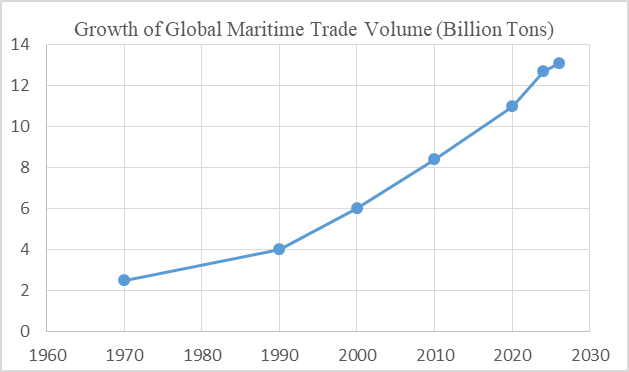
Growth of Global Maritime Trade
Despite advances in air and land transport, shipping remains dominant for three main reasons. First, economies of scale make it far more cost-effective. A single ultra-large container vessel can carry tens of thousands of containers, something no other mode of transport can match. Second, heavy commodities such as oil, coal, and iron ore can only realistically be transported by sea or pipeline. Third, maritime infrastructure—especially ports—is long-lasting and globally connected.
In practice, this means that even though the oceans are vast, global trade is funneled through a limited number of narrow routes. This creates a paradox: chokepoints improve efficiency but also concentrate risk.
Cases of Chokepoint Disruptions
Maritime chokepoints have repeatedly demonstrated their vulnerability through both historical and recent disruptions, underscoring their central role in sustaining the global economy. A well-known example is the Suez Canal blockage, when a single vessel obstructed the Suez Canal for six days, halting nearly $9–10 billion in daily trade and creating a backlog of hundreds of ships. More recently, insecurity around the Bab el-Mandeb has forced major shipping lines to reroute vessels around the Cape of Good Hope, significantly increasing transit time and raising freight costs by up to 30–50%. Environmental vulnerability has also been exposed in the Panama Canal, where prolonged drought conditions reduced water levels, limiting vessel movement and constraining global shipping capacity. Earlier, piracy in the Strait of Malacca highlighted security risks, leading to higher insurance premiums and necessitating coordinated naval patrols.
The Strait of Hormuz which had been handling 20–21 million barrels of oil per day (roughly 20% of global consumption), led to a partial closure due to geopolitical tension between Israel-US and Iran since February 28, 2026. This event sent Brent crude prices toward $120 per barrel. The “Hormuz Toll,” an illegal fee imposed by regional actors, added a “sovereignty tax” to every barrel of oil that manages to leak through, demonstrating how a single chokepoint can be used as a weapon of economic warfare.
Beyond energy markets, airline fuel costs increased, leading to 10–25% higher airfares on long-haul routes, which in turn has negatively affected international tourism demand. Shipping has also been impacted, with war-risk insurance premiums in the Gulf rising by 200–400% during peak tensions, significantly increasing the cost of maritime transport. From a legal perspective, the situation highlighted tensions with the United Nations Convention on the Law of the Sea (UNCLOS), particularly the principle of transit passage; Iran’s partial acceptance of this framework added further uncertainty.
The consequences of these disruptions extended far beyond shipping delays. Economically, disruptions at chokepoints increased transportation costs, which are eventually passed on to consumers. The United Nations Conference on Trade and Development (UNCTAD) has noted that higher freight rates can contribute to global inflation, particularly in developing economies.
Thus, Maritime chokepoints face multiple threats including geopolitical tensions, terrorism and armed attacks, piracy, environmental challenges, accidents and blockages, overcrowding and congestion, legal and political disputes and cyber security threats making them highly vulnerable points in the global trade network.
Strategies for Managing Chokepoint Risks
To manage these risks, countries and companies have developed several strategies. One common approach is route diversification, where ships use alternative paths when major routes are disrupted. For example, vessels may travel around the Cape of Good Hope if the Suez Canal is unavailable, even though it increases costs and delays.
Another important measure is the use of strategic petroleum reserves. Countries maintain emergency oil stockpiles that can be released during supply disruptions to stabilize markets and prevent sudden price spikes.
Naval presence also plays a key role. Major powers deploy naval forces to protect shipping lanes, deter piracy, and ensure safe passage through critical regions. These efforts are often supported by international cooperation and agreements that aim to keep sea routes open under frameworks such as the United Nations Convention on the Law of the Sea.
Infrastructure development further reduces dependence on chokepoints. Pipelines, expanded ports, and rail connections provide alternative ways to transport goods, although they cannot fully replace maritime routes.
In addition, advances in technology have improved shipping safety and efficiency. Real-time tracking systems, better navigation tools, and data-driven route planning help ships avoid risks. Financial tools such as insurance and hedging also help companies manage economic uncertainty.
Finally, companies are increasingly focusing on supply chain resilience. Instead of relying entirely on just-in-time systems, many are building buffer inventories, diversifying suppliers, and shifting some production closer to key markets.
Evaluation of These Strategies
While these measures have made the global shipping system more resilient, they have not eliminated the risks associated with chokepoints. Alternative routes remain slower and more expensive, and infrastructure solutions often lack the capacity to fully replace major sea routes. Strategic reserves provide only temporary relief, and military protection cannot fully prevent geopolitical conflicts. In addition, international cooperation can weaken during periods of political tension.
As a result, even short disruptions can still lead to significant economic consequences, including higher shipping costs, supply shortages, and inflation. This shows that while the system has improved, it remains fundamentally vulnerable.
Conclusion
Maritime chokepoints are essential to the functioning of the global economy. They make modern trade faster and more efficient, but they also introduce significant risks by concentrating global traffic into narrow and often unstable regions. As global trade continues to expand, the importance of these chokepoints will only increase. Ensuring their security and reliability will require a balanced approach that combines international cooperation, technological innovation, and strategic planning. Ultimately, the global economy does not depend only on vast oceans or advanced technology. It depends on a handful of narrow passages—and how well the world manages them.
Works Cited
International Maritime Organization. (2023). International shipping facts and figures. https://www.imo.org
United Nations Conference on Trade and Development. (2023). Review of Maritime Transport 2023. United Nations. https://unctad.org
U.S. Energy Information Administration. (2024). World Oil Transit Chokepoints. https://www.eia.gov
International Energy Agency. (2024). Oil Market Report. https://www.iea.org
World Bank. (2022). The Impact of Global Supply Chain Disruptions. https://www.worldbank.org
Organization for Economic Co-operation and Development. (2022). Global Supply Chains: Efficiency and Risks in the Maritime Sector. https://www.oecd.org