



-
economicmargins
-
 July 20, 2026
 -
 Nepalese Economy
Nepal Budget 2026/27: An Analysis of Economic Priorities, Structural Reforms, and Growth Prospects
Nepal’s Budget for Fiscal Year (FY) 2026/27, which starts from July 17 th , 2026, and ends on July 15 th , 2027, is presented by Dr. Swarnim Wagle, Finance Minister of the newly elected government of Nepal.With a total outlay of Rs. 2.124 trillion, the budget is approximately 25 percent higher than the revised estimate of the previous fiscal year.It targets 7 percent economic growth, limit inflation to 5.5 percent, aims to reduce the fiscal deficit through improved domestic revenue mobilization while continuing investment in strategic sectors.The budget reflects a gradual policy shift from consumption-driven growth towards productivity-led development. Priority has been given to infrastructure completion rather than launching new projects, commercialization of agriculture, information technology and artificial intelligence, digital governance, tourism recovery, industrial development, and export promotion.
Budget Composition
The expenditure structure highlights a persistent feature of Nepal’s public finances—recurrent expenditure continues to dominate the budget. Nearly three-fifths of total expenditure is allocated to salaries, pensions, social security allowances, grants, and other administrative obligations. While these expenditures are essential for maintaining government operations and delivering public services, they also reduce the fiscal space available for productive investment.
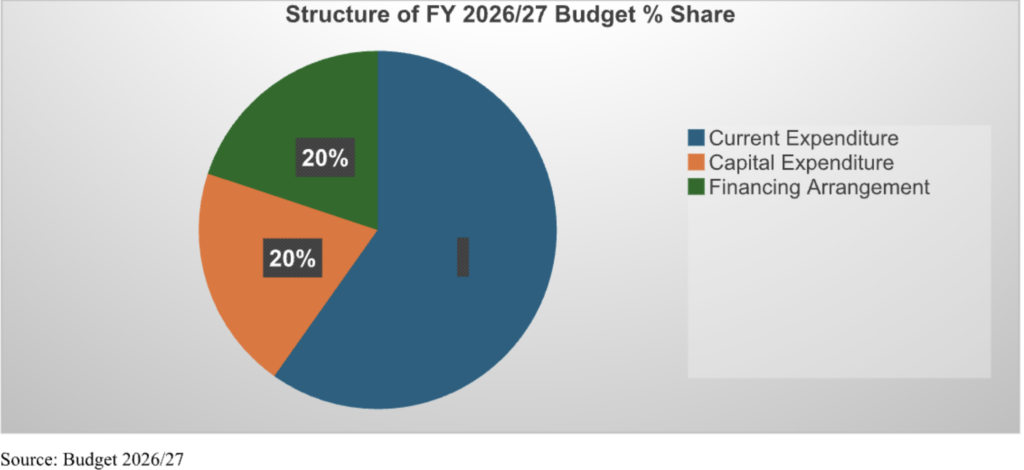
Capital expenditure accounts for around 20 percent of the total budget. Although the nominal allocation has increased compared with previous years, Nepal’s challenge lies less in allocating funds than in spending them efficiently. According to Financial Comptroller General Office (FCGO) data, Nepal has utilized only about 60% of its budgeted capital expenditure on average over the last decade due to of procurement delays, weak project preparation, contract management issues, land acquisition problems, and limited coordination among federal, provincial, and local governments, etc.
Financial management expenditure, which includes debt repayment and principal repayments, now represents almost one-fifth of the budget. Out of the total planned public borrowing of Rs. 657.28 billion in FY 2026/27, nearly two-thirds (63.6%) has to be used for debt servicing, rather than financing new development projects. This reflects Nepal’s increasing debt obligations and highlights the importance of ensuring that borrowed resources has to be used to finance projects capable of generating long-term high economic returns.
Budget Financing
To finance the FY 2026/27 budget, the government expects to mobilize resources from four principal sources; domestic revenue, foreign grants, domestic borrowing and foreign loans.
Capital expenditure accounts for around 20 percent of the total budget. Although the nominal allocation has increased compared with previous years, Nepal’s challenge lies less in allocating funds than in spending them efficiently. According to Financial Comptroller General Office (FCGO) data, Nepal has utilized only about 60% of its budgeted capital expenditure on average over the last decade due to of procurement delays, weak project preparation, contract management issues, land acquisition problems, and limited coordination among federal, provincial, and local governments, etc.
Financial management expenditure, which includes debt repayment and principal repayments, now represents almost one-fifth of the budget. Out of the total planned public borrowing of Rs. 657.28 billion in FY 2026/27, nearly two-thirds (63.6%) has to be used for debt servicing, rather than financing new development projects. This reflects Nepal’s increasing debt obligations and highlights the importance of ensuring that borrowed resources has to be used to finance projects capable of generating long-term high economic returns.
Budget Financing
To finance the FY 2026/27 budget, the government expects to mobilize resources from four principal sources; domestic revenue, foreign grants, domestic borrowing and foreign loans.
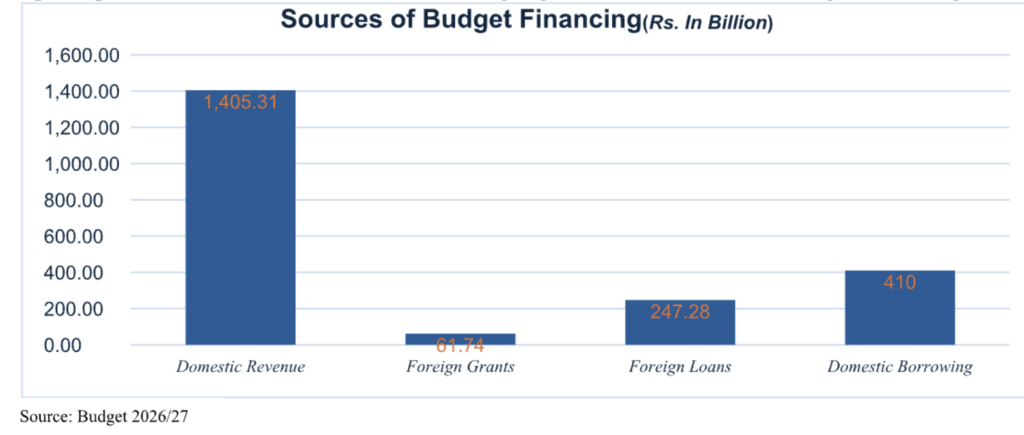
Financing through domestic revenue is approximately two-thirds of total expenditure. Government has given continued emphasis on strengthening tax administration, expanding the tax base, and improving compliance through digital systems rather than relying solely on new tax measures.
Foreign grants account for less than 3 percent of total financing, shows the long-term decline in grant assistance, thus Nepal gradually transitions from grant-supported development to loan-financed infrastructure investment. While concessional foreign loans remain an important source of development finance, their growing use also requires careful debt management.
Domestic borrowing of Rs. 410 billion, equivalent to nearly one-fifth of total financing, represents another important component of the fiscal strategy. Borrowing can accelerate infrastructure development when invested in productive assets. However, excessive domestic borrowing may create crowding-out effects, reducing the availability of credit to the private sector and increasing interest rates, thereby discouraging private investment. Maintaining an appropriate balance between public borrowing and private sector financing will therefore be critical for sustaining economic growth.
Changing Priorities for a More Competitive Economy
Compared to earlier budgets that primarily emphasized expanding public expenditure, the current budget places greater emphasis on improving productivity, encouraging private sector investment, promoting digital transformation, and strengthening economic competitiveness.
Infrastructure continues to receive one of the largest shares of the federal budget, reaffirming its importance for long-term economic development. However, unlike previous budgets that focused on launching numerous new projects, the budget emphasizes timely completion of ongoing national pride projects, including highways, tunnels, transmission lines, and airports.
Energy sector remains a strategic priority, with increased emphasis on hydropower generation, transmission infrastructure, and cross-border electricity trade recognizing as a major source of foreign exchange earnings.
Agriculture continues to play an important role in employment and rural livelihoods. The budget shifts the focus from traditional subsidy-driven support to improving productivity through irrigation, mechanization, value-chain development, storage facilities, and commercialization.
Tourism has been recognized as a key driver of employment and foreign exchange. The budget seeks to promote high-value tourism by improving destinations, tourism infrastructure, heritage conservation, and international marketing. It also prioritizes strengthening aviation safety standards and efforts to remove Nepal from the European Union’s Air Safety List to improve international connectivity and boost tourist arrivals.
Digital Economy and Artificial Intelligence have emerged as new development priorities. Compared with previous budgets, greater importance has been given to digital infrastructure, data centers, cybersecurity, artificial intelligence (AI), digital governance, and information technology. This reflects a broader policy shift towards building a knowledge-based economy capable of generating high-value employment, supporting innovation, and improving public service delivery.
Private Sector has been identified as the primary engine of economic growth. It introduces measures to simplify tax administration, improve the investment climate, reduce regulatory barriers, encourage entrepreneurship, and facilitate investment by Non-Resident Nepalis (NRNs).
Education, health, and social protection continue to receive significant attention in the FY 2026/27 budget as well. In education, the focus is on improving the quality of education through technical and vocational training, digital learning, research, innovation, and skills development that match labor market needs, although its share of the total budget has gradually declined over the years. In the health sector, the budget emphasizes better healthcare infrastructure, expanded health insurance, improved medical equipment, and better service delivery. The government also continues to allocate a large amount for social security allowances, pensions, and welfare programs to support vulnerable groups.
Structural Reforms: Moving Beyond Budget Allocations
One of the distinguishing features of the FY 2026/27 (2083/84) budget is its emphasis on structural reforms alongside expenditure allocations. Recognizing that higher public spending alone cannot deliver sustained economic growth, the budget proposes a series of institutional, fiscal, and regulatory reforms aimed at improving governance, strengthening the investment climate, and enhancing the efficiency of public administration.
A key reform is the rightsizing of the government. The budget announces the reduction of federal ministries from 22 to 18, by restructuring of departments, public agencies, and organizational structures to eliminate duplication and improve administrative efficiency. This initiative is intended to reduce recurrent expenditure at the same time enabling the government to deliver public services more effectively and efficiently.
On the tax policy reforms to improve competitiveness and encourage private investment, it doubles the personal income tax exemption threshold to Rs. 1 million, reduces the highest personal income tax rate by 10 percentage points, reduces customs duty slabs from 11 to 7, abolishes excise duty on 360 goods, and lowers customs duties on 273 industrial raw materials. These measures aim to reduce the tax burden on businesses and individuals while improving the competitiveness of domestic industries at the same time increasing effective demand in the economy.
Another important reform is the digital transformation of revenue administration. The government plans to establish a paperless, faceless, and contactless tax administration system by expanding digital tax filing, electronic payments, automated VAT refunds, and AI-based risk assessment for tax audits. In addition, businesses with an annual turnover exceeding Rs. 100 million will be required to integrate with the Central Billing Monitoring System, strengthening tax compliance and reducing revenue leakage.
The budget also plans to modernize Nepal’s capital market by restructuring the Nepal Stock Exchange (NEPSE), introducing instruments such as intra-day trading, short selling, and derivatives in a phased manner, and allowing eligible Nepali companies to issue Global Depository Receipts (GDRs) in international markets. These reforms are expected to broaden investment opportunities and improve access to long-term capital.
It proposes the establishment of a Governance Innovation Challenge Fund to incentivize provincial and local governments to adopt innovative approaches for improving public service delivery and governance. The budget announces the creation of a Sovereign Wealth Fund in order to channel surplus forex reserve into long-term investments for future economic resilience. To improve tax compliance, it introduces a tax lottery system that rewards consumers for demanding VAT invoices, thereby encouraging formal transactions and reducing tax evasion.
These initiatives reflect the government’s commitment to strengthening governance, promoting fiscal transparency, and laying the foundation for sustainable long-term economic development.
Nepal’s Budget Trends: Bigger Budgets, Modest Economic Outcomes
Over the past decade, Nepal’s federal budget has expanded dramatically—from Rs. 404.8 billion in FY 2012/13 to Rs. 2.124 trillion in FY 2026/27, an increase of more than five times. This rapid fiscal expansion has been accompanied by rising actual government expenditure, widening fiscal deficits, and a steady increase in public debt.
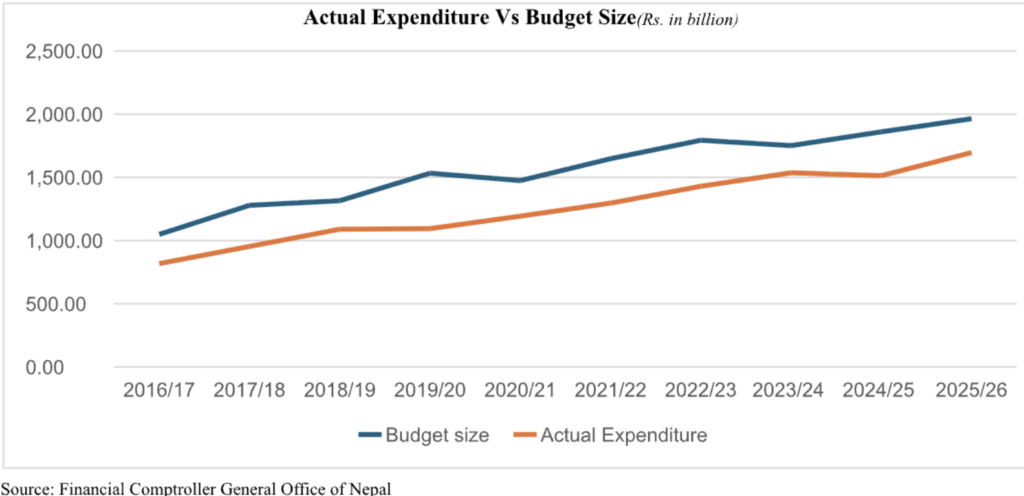
During this period, Nepal has recorded an average fiscal deficit of around 5% of GDP, while public debt has increased from below 25% of GDP a decade ago to around 47% of GDP in recent years. Although Nepal’s budget size has increased steadily over the past decade, actual expenditure averaged only about 84% of the allocated budget, reflecting persistent challenges in budget execution and implementation. More than that, despite substantial increase in public spending, economic outcomes have remained modest, with real GDP growth has remained on average around 4% annually over the last decade. More than 600,000 Nepalis leave the country each year for foreign employment, reflecting limited domestic employment opportunities. At the same time, agriculture’s share of GDP has declined from about 33% to around 24%, while manufacturing contributes only about 5% of GDP, indicating weak structural transformation. Nepal also remains heavily import-dependent country, with imports exceeding Rs. 1.7 trillion annually—more than ten times the value of exports, resulting in a persistent trade deficit. These trends suggest that despite a much larger budget, Nepal has yet to generate sufficient productive employment, expand its industrial base, or reduce its dependence on external markets.
These trends indicate that the expansion of the budget has not been matched by comparable improvements in economic transformation. The persistent gap between budget allocations and actual expenditure—particularly in capital spending—shows that larger budgets have not necessarily translated into better development outcomes. Thus, Nepal’s fiscal challenge today is less about the size of the budget and more about the quality, efficiency, and developmental impact of public spending. A stronger focus on execution, prioritization of high-return investments, and improved governance is essential to ensure that the higher public expenditure generate sustainable and inclusive economic growth.
Final Evaluation
The FY 2026/27 budget represents a meaningful shift in Nepal’s fiscal policy from an expenditure-oriented approach towards productivity, competitiveness, and structural transformation. Rather than announcing many new projects, the government has prioritized the completion of ongoing infrastructure, commercialization of agriculture, promotion of information technology and artificial intelligence, export-oriented industrialization, digital governance, and private sector-led economic growth. The introduction of institutional reforms such as government rightsizing, modernization of tax administration, capital market reforms, and innovative initiatives including the Governance Innovation Challenge Fund and Sovereign Wealth Fund demonstrates an intention to improve governance alongside public spending.
Nevertheless, the budget also faces significant implementation challenges. Recurrent expenditure continues to account for nearly 60 percent of total expenditure, leaving limited fiscal space for productive capital investment. Rising public debt, increasing debt-servicing obligations, persistent underutilization of capital expenditure, and continued dependence on domestic borrowing remain important fiscal concerns. Moreover, Nepal’s past experience shows that ambitious budget allocations have often not translated into proportional improvements in economic growth, employment generation, productivity, or private investment because of weak project execution and institutional inefficiencies.
Whether the budget succeeds will therefore depend less on the size of allocations and more on the government’s ability to implement reforms effectively, complete projects on schedule, improve coordination among the three tiers of government, strengthen public financial management, and create a predictable environment for private investment. If implementation remains weak, many of the proposed reforms may produce only limited economic impact despite their sound policy direction.
Conclusion
The FY 2026/27 budget presents an ambitious roadmap for improving Nepal’s economic competitiveness and long-term growth prospects. If the proposed reforms are implemented effectively and supported by strong governance, the budget can lay the foundation for a more productive, resilient, and sustainable economy. The ultimate measure of its success, however, will depend not on the size of the budget but on the quality and effectiveness of its implementation.