


-
economicmargins
-
 July 3, 2026
 -
 Investment Insights
Understanding Nepal’s Capital Market Before You Invest
“The stock market is a device for transferring money from the impatient to the patient.” — Warren Buffett
These words capture a timeless truth: wealth is rarely created overnight. Instead, it is built gradually through disciplined investing, patience, and sound decision-making. In today’s digital age, opening a Demat account, applying for an Initial Public Offering (IPO), or trading shares on the secondary market can be completed within minutes. While investing has become easier than ever, investing wisely remains equally challenging.
Many first-time investors enter the market with unrealistic expectations, relying on rumors, social media speculation, or short-term price movements instead of understanding the businesses in which they invest. Many mistakenly view the stock market as a place for quick profits rather than a platform for long-term wealth creation. As a result, many investors loose their hard-earned money as well. Thus, investors should view the capital market not as a gambling arena but as a vehicle for long-term compounding. Before risking hard-earned savings, it is important to understand the regulatory landscape, macro-economic data, and risk-management principles that govern Nepal’s financial ecosystem.
What Is the Capital Market and Why It Matters
A capital market is a financial marketplace where businesses and governments raise long-term funds by issuing securities like shares and bonds, while investors provide capital in exchange for ownership stakes or future yields. It connects individuals who have savings with businesses and institutions that need capital to expand operations, invest in new projects, or create employment.
Unlike banks that lend money, capital markets allow companies to raise funds directly from the public by issuing shares and debt securities. Investors, in return, become shareholders or lenders and earn returns through dividends, capital gains, or interest income. A well-developed capital market contributes significantly to economic growth by:
- Mobilizing household savings into productive investment.
- Financing businesses and infrastructure projects.
- Creating employment opportunities.
- Encouraging entrepreneurship and innovation.
- Improving corporate governance and transparency.
As economies develop, capital markets become increasingly important in channeling financial resources toward productive sectors.
Nepal’s Capital Market: From Modest Beginnings to Digital Transformation
Nepal’s organized securities market began with the establishment of the Nepal Stock Exchange (NEPSE) in 1993. Initially, the market was small, trading volumes were limited, and transactions relied heavily on physical share certificates. Nepal’s capital market has experienced remarkable growth over the past two decades, with the expansion of financial sector and increased public participation in investment. Around 2005, the market was still in its early stage, with approximately 130 listed companies and a total market capitalization of less than Rs. 100 billion, representing only about 12% of the country’s Gross Domestic Product (GDP). Investment opportunities were limited, share trading was conducted manually, and Demat accounts and online trading systems had not yet been introduced.
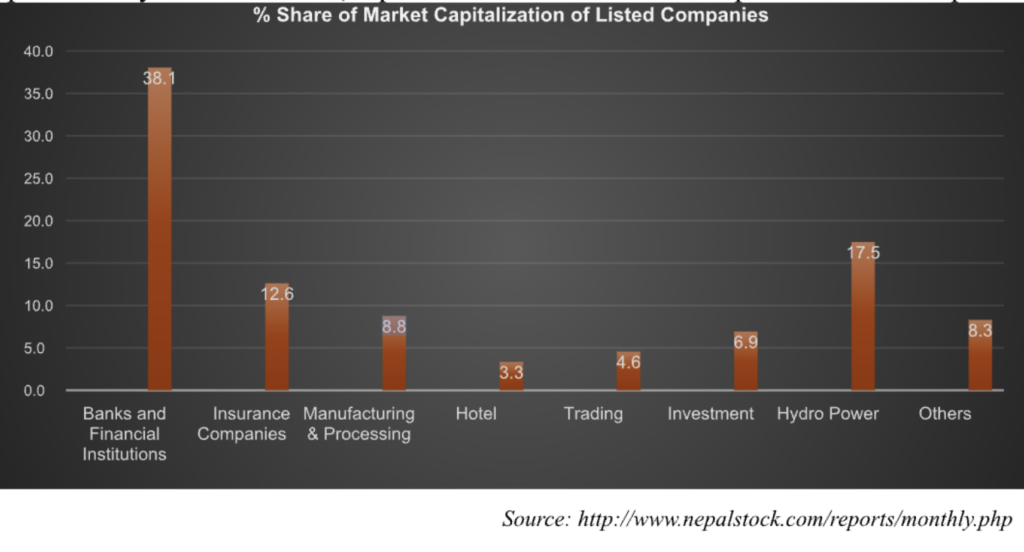
By 2015, the number of listed companies had increased to around 220, while market capitalization had grown to nearly Rs. 1.9 trillion, equivalent to approximately 65% of GDP. During this period, major reforms—including the introduction of electronic trading, Demat accounts, the ASBA system for IPO applications, and online investment services—began transforming Nepal’s securities market into a more efficient and accessible financial ecosystem.
Source: http://www.nepalstock.com/reports/monthly.php
As of 2025/26, Nepal’s capital market has become significantly larger and more sophisticated. More than 280 companies are listed on the Nepal Stock Exchange (NEPSE), with total market capitalization reaching approximately Rs. 4.5 trillion, equivalent to about 73% of Nepal’s GDP. The rapid adoption of digital technology has further accelerated investor participation, with more than 7.8 million Demat accounts—equivalent to roughly 25% of the country’s population. Although the actual number of unique investors is lower because some people maintain multiple accounts, the figures demonstrate the rapid expansion of financial inclusion and investor participation over the past decade. Online trading platforms, electronic settlements, and digital IPO applications through ASBA and Mero Share have made investing accessible to citizen across and outside of the country, marking a significant transformation from a predominantly paper-based market two decades ago. This evolution highlights Nepal’s progress toward a more inclusive, transparent, and technology-driven capital market capable of supporting long-term economic growth and wealth creation. However, the rapid increase in investor participation also highlights the need for greater financial literacy. Opening an investment account has become simple; understanding investment remains considerably more demanding.
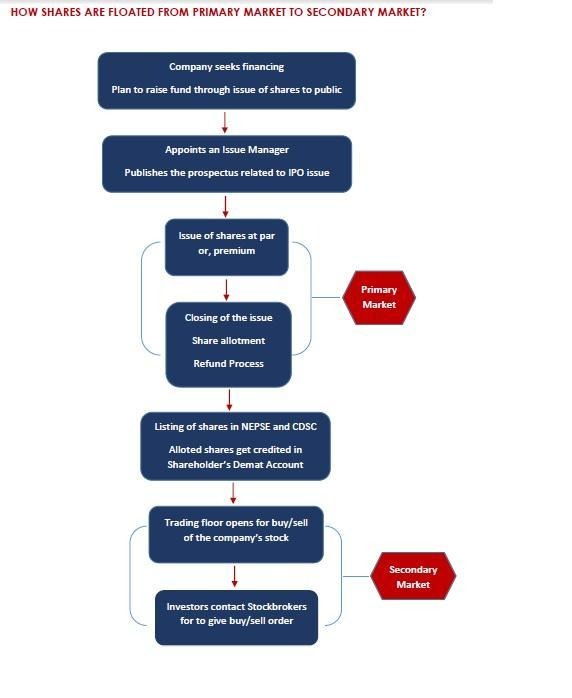
Nepal’s capital market operates through two interconnected segments: the primary market and the secondary market, both of which play a vital role in mobilizing savings for economic development. The primary market is where companies and institutions raise fresh capital by issuing securities to the public for the first time through Initial Public Offerings (IPOs), Follow-on Public Offerings (FPOs), rights shares, mutual fund units, and debentures. The funds collected are used to finance business expansion, infrastructure development, technological upgrades, and other productive investments.
Once securities are listed, they are traded in the secondary market through the Nepal Stock Exchange (NEPSE), Nepal’s only stock exchange. Investors buy and sell shares through more than 50 licensed stock brokers, while the CDS and Clearing Limited (CDSC) maintains over 7.8 million Demat accounts and manages electronic settlement and ownership records. The issuance process is regulated by the Securities Board of Nepal (SEBON), while more than 30 licensed merchant bankers act as issue managers, underwriters, and portfolio managers, ensuring that public offerings comply with regulatory requirements and provide adequate disclosures to investors for both markets.
Nepal’s capital market offers a variety of investment options to suit different financial goals and risk preferences. IPOs provide an attractive starting point for new investors, while mutual funds offer professionally managed and diversified portfolios. Corporate debentures are suitable for investors seeking stable and predictable income with relatively lower risk. For long-term wealth creation, listed shares traded on the Nepal Stock Exchange offer the potential for capital appreciation and dividend income, whereas active trading may generate higher returns but involves significantly greater risk. A diversified portfolio that combines different investment instruments can help balance risk and improve long-term returns.
Common Misconceptions Among New Investors
One of the most common misconceptions about Nepal’s capital market, as in many emerging economies, is that investing and speculation are the same. In reality, investing involves purchasing shares of fundamentally strong companies after evaluating factors such as financial performance, profitability, dividend history, corporate governance, and management quality, with the goal of creating long-term wealth. Speculation, on the other hand, is driven primarily by short-term price movements, market rumors, social media hype, or unverified tips in the hope of making quick profits. As legendary investor Warren Buffett aptly stated, “Risk comes from not knowing what you’re doing,” reminding investors that informed decisions—not speculation—are the foundation of successful investing.
The Share Market Is Gambling: One of the most common misconceptions is that investing in the stock market is no different from gambling. While short-term speculation exists, the capital market is basically a platform for investing in real businesses that generate profits, create jobs, pay taxes, and contribute to economic growth. Although share prices may fluctuate in the short term, their long-term value is driven by the financial performance and growth prospects of the related companies.
Prices Only Move Upward: Factors such as economic conditions, interest rates, political developments, corporate performance, and investor sentiment influence market prices. Short-term declines are a normal part of investing and do not necessarily indicate a weak market.
IPOs Always Guarantee Profits: Many investors believe every IPO will deliver immediate gains, but this is no longer true. While many IPOs in Nepal have historically listed at premiums above their face value of Rs. 100, returns now vary depending on a company’s financial strength, business model, growth potential, and market conditions. Investors should evaluate each IPO on its merits rather than assume guaranteed profits.
A Lower Share Price Means Better Value: Many investors assume that a lower-priced share is a better bargain, but a share’s price alone says little about its true value. A stock trading at Rs. 1,000 may be better value than one trading at Rs. 100 if its earnings, growth prospects, and financial strength are stronger. Smart investors focus on a company’s intrinsic value rather than its nominal share price.
Managing Risk Without Fearing It
Risk is an unavoidable component of investing. The objective is not to eliminate risk—an impossible task—but to understand and manage it intelligently. Before investing in Nepal’s capital market, every investor should carefully evaluate the following factors to make informed and disciplined financial decisions:
- Define Your Investment Goals: Determine whether your objective is long-term wealth creation, regular income, retirement planning, or achieving a specific financial milestone.
- Assess Your Risk Tolerance: Understand how much risk you are willing and financially able to take. Higher potential returns are generally accompanied by higher levels of risk.
- Conduct Thorough Research: Analyze a company’s financial performance, management quality, industry outlook, and growth prospects before making any investment decision.
- Monitor Market Conditions: Economic trends, interest rates, inflation, government policies, and overall market sentiment can significantly influence investment performance.
- Consider Your Investment Horizon: Long-term investing generally provides greater opportunities to benefit from compounding and reduces the impact of short-term market volatility.
- Evaluate Investment Costs: Brokerage commissions, taxes, and other transaction costs should be considered, as they directly affect overall investment returns.
- Maintain Strong Financial Health: Build an emergency fund and avoid excessive debt before investing to reduce the likelihood of selling investments during unfavorable market conditions.
- Develop a Clear Investment Strategy: Invest systematically based on your financial goals rather than reacting to market rumors or short-term price movements.
- Diversify Your Portfolio: Spread investments across different asset classes, sectors, and securities to reduce overall portfolio risk and improve long-term stability.
- Stay Updated on Regulations: Keep informed about policies and regulations issued by the Securities Board of Nepal (SEBON), the Nepal Stock Exchange (NEPSE), and CDS and Clearing Limited (CDSC), as regulatory changes can affect investment opportunities and market operations.
Conclusion
Nepal’s capital market should neither be viewed as a shortcut to instant wealth nor dismissed as an arena reserved for speculators. It is an essential platform that mobilizes savings, finances economic growth, supports entrepreneurship, and enables ordinary citizens to participate in the country’s development through ownership of productive enterprises. For new investors, the biggest investment is not the purchase of a share but the acquisition of knowledge. Markets will inevitably rise and fall, and individual companies will experience periods of success and difficulty. Those who approach investing with patience, discipline, careful analysis, and realistic expectations are far more likely to achieve long-term financial success than those who chase quick profits.
Warren Buffett perhaps summarizes this philosophy best: “The best investment you can make is an investment in yourself.”
For every aspiring investor in Nepal, that investment begins with financial education. Once knowledge becomes the foundation of investment decisions, the capital market transforms from a place of uncertainty into a powerful instrument for building personal prosperity and contributing to the nation’s economic progress.