

-
economicmargins
-
 April 3, 2026
 -
 Global Economy
Financial Literacy for the Future: Why Global Money Week Matters
GMW is an annual global awareness-raising campaign to ensure that young people, from an early age, are financially aware, and are gradually acquiring the knowledge, skills, attitudes and behaviors necessary to make sound financial decisions and ultimately achieve financial well-being and financial resilience. The campaign is coordinated by the OECD and implemented by national authorities. Throughout 13 editions, starting in 2012, GMW has reached over 71 million children and young people in 176 countries and territories worldwide.
In today’s increasingly complex financial environment with the advent of digital finance, financial literacy has become an essential life skill. From managing personal budgets to understanding investment options and navigating credit systems, cyber risk individuals need financial skills to make informed decisions that impact their present and future economic well-being. It has become more important day by day for young people to learn how to perform financial activities such as saving, opening a bank account, making online payment, learning how to invest, be aware of scams, etc. Without these skills, young people may become careless, become victim of scams and may face financial problems. Realizing the importance of financial literacy from early age, Global Money Week as a worldwide program has been launched in 2012 to make children and youth smart with money matters. It helps them build good habits and gives them the knowledge they need to make wise financial choices from now to throughout their lives.
Financial literacy is an ability to effectively manage the economic well-being of individuals with knowledge and financial skills; it is about empowering individuals to make informed financial decisions. As financial services become more digital and sophisticated, young people must be able to evaluate financial risks, avoid scams, and plan for their financial futures. Global Money Week provides an opportunity for governments, regulators, financial institutions, schools, and civil society organizations to work together in promoting financial education and encouraging youth to acquire financial knowledge.
Global Financial Literacy Situation
According to The Standard & Poor’s Global Financial Literacy Survey, which covers more than 140 countries, only about 33% of adults globally are financially literate. This indicates that they can understand basic concepts such as saving, borrowing, interest rates, inflation, risk diversification, etc. The study, conducted in collaboration with the World Bank, Gallup, and the Global Financial Literacy Excellence Center, highlights that financial literacy is strongly linked to income levels, education, and access to financial services. The report shows significant regional differences: developed economies such as those in North America and Europe tend to have higher financial literacy rates (often above 50%), while South Asia, Sub-Saharan Africa, and parts of Latin America have much lower levels. It also identifies a persistent gender gap, with men generally scoring higher than women across most countries. Young adults and the elderly are also found to have comparatively lower financial knowledge. The survey emphasizes that financial literacy is not just about knowledge, but also about the ability to apply that knowledge in real-life decisions, such as saving, borrowing, investing, and planning for retirement.
Various studies indicate that only about one-third of adults globally have basic financial knowledge related to interest rates, inflation, and risk diversification. Financial literacy rates vary significantly across countries and regions. Developed economies such as the United States, Germany, Japan, and Australia generally report financial literacy levels between 55 and 70 percent. These higher rates are often associated with strong education systems, widespread access to financial services, and well-developed financial markets. In emerging economies such as China, India, Brazil, and South Africa, financial literacy rates range between 35 and 50 percent. These countries have made significant progress in expanding financial inclusion, but disparities in education and income levels still affect financial knowledge among the population. Many low-income and developing countries report financial literacy rates between 15 and 30 percent. Limited access to financial institutions, lower levels of financial education, and the prevalence of informal economic activities contribute to these lower literacy levels. These disparities highlight the importance of continued global efforts to improve financial education, particularly among young people for better future of financial systems and economy as well.
History of Global Money Week
Global Money Week was initiated by Child and Youth Finance International in 2012 with the aim of raising financial awareness among young people worldwide. Later, the initiative came under the coordination of the Organization for Economic Co-operation and Development through its International Network on Financial Education. Then the campaign is led by OECD and held annually, usually in March, addressing the importance of ensuring that young people are given the opportunity to be more financially aware, and to continue to gain key skills, knowledge, attitudes and behaviors. One National authority of each country takes lead role to organize the campaign in their country. About 21 countries participated and approximately 33,000 children and youth were involved in various financial education activities in 2012. However, the campaign quickly gained global attention and by 2013, around 80 countries participated, reaching nearly one million young people. In 2014, participation increased to more than 118 countries with around three million youth engaged in financial literacy activities. Over the years, the campaign continued to expand rapidly, reaching more than 176 countries and territories and engaging over 71 million youths worldwide.
Governments, central banks, financial institutions, schools, universities, and non-governmental organizations organize a wide range of activities such as financial literacy workshops, school competitions, youth debates, savings campaigns, interactive learning sessions, and social media awareness programs during the week. These activities aim to teach young people fundamental financial concepts such as budgeting, saving, investing, responsible borrowing, and consumer protection.
Each year, Global Money Week is guided by a theme or slogan that highlights key aspects of financial education. These themes encourage youth to think about financial responsibility and develop healthy financial habits.
- 2012: Child Finance Day/Week – The “Hello World” moment. The goal was simply to get people to acknowledge that kids need to be part of the conversation about money.
- 2013: Connect – This was about introductions. It encouraged banks and financial experts to actually talk to kids and bridge the gap between “scary” institutions and young people.
- 2014: First Steps in Finance – The “basics” year. It focused on teaching the very first lessons, like what a bank is and why we use money.
- 2015: Save Today. Safe Tomorrow. – A classic “rainy day” lesson. If you put a little aside now, you won’t be in a panic when an emergency happens later.
- 2016: Take Part. Save Smart! – This moved from “just saving” to “saving with a plan.” It encouraged kids to be active and clever about how they managed their coins.
- 2017–2020: Learn. Save. Earn. – This slogan was so good they used it for years. It’s the “Triple Threat” of money: get the knowledge, keep your money, and then figure out how to make more of it through work or business.
- 2021: Take Care of Yourself, Take Care of Your Money – Coming right out of the pandemic, this was a reality check. It linked mental/physical health with financial health—stressing that being “broke” is bad for your overall well-being.
- 2022: Build Your Future, Be Smart About Money – The 10th anniversary theme. It was a call to look at the big picture: every dollar you spend or save today is a brick in the house you’re building for your future self.
- 2023: Plan Your Money, Plant Your Future – This added a “green” twist. It wasn’t just about personal wealth, but also about how our spending affects the planet and sustainability.
- 2024: Protect Your Money, Secure Your Future – The “Anti-Scam” year. With so many online hacks and frauds, the focus shifted to keeping your money safe from people trying to steal it.
- 2025: Think Before You Follow, Wise Money Tomorrow – This is the “TikTok/Instagram” lesson. It warns young people not to trust every “get rich quick” scheme or “finfluencer” they see on social media.
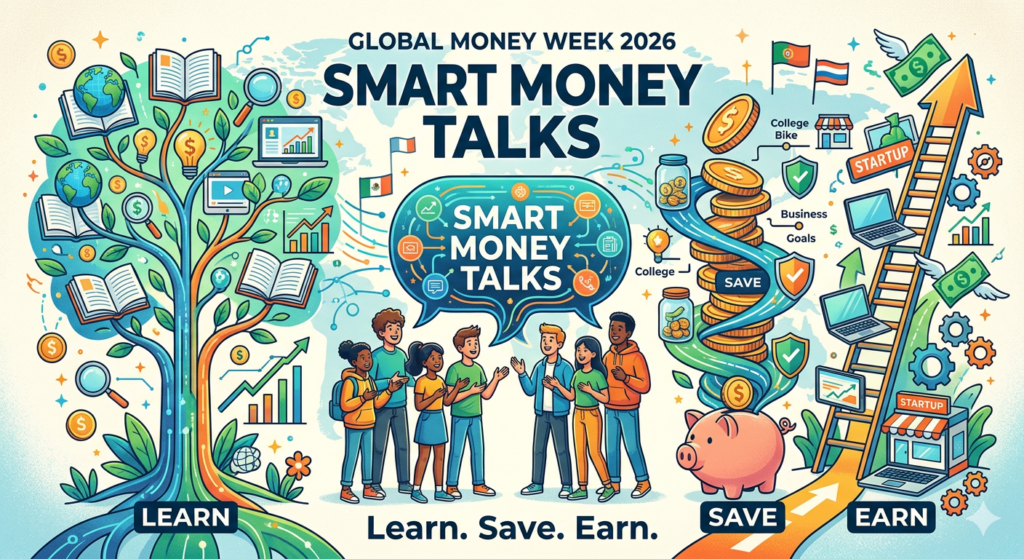
In 2026, Global Money Week is celebrated from 16 to 22 March under the theme “Smart Money Talks.” The slogan encourages open and informed conversations about money among young people, families, educators, and financial institutions. In a world where financial information spreads quickly through social media and digital platforms, discussing about money openly helps young people distinguish between reliable advice and misleading information. The theme therefore emphasizes the importance of financial discussion and informed decision-making.
Young people’s financial lives are full of decisions, though at first it doesn’t seems so important. Many of them enter early adulthood thinking they already understand money. How to budget, pay taxes, manage student loans and plan ahead. In reality, many young people do not. From receiving money from parents to earning the first money, managing student loans, understanding investments, watching out for scams, keeping track of spending while keeping up with friends, they have to make wise decision at every step. Many young people may not feel confident in asking money-related questions, do not know who they should talk to about money or may be afraid to share about their money problems. By speaking up, sharing stories, and asking questions to the right people, young people can gain the confidence and skills they need to manage money wisely. Financial education gives the tools – from budgeting basics to navigating digital finance – to open conversations that can prevent anxiety and mistakes. Financial literacy can empower young people to build healthier financial habits, avoid pitfalls, and take control of their journey toward financial well-being.
For example, at the age of 18 or 19, many youths have to make big financial decision. Student going to university abroad or far from home and applying for a student loan, needs to understand the terms and conditions explained to them and written on paper. Still, they do not fully understand what they are committing to. Most do not know how interest would affect the total loan over time, or how repayment would shape future finances. On such moment, they feel that they should understand it, so they hesitate to ask as many questions as they should have.
The lack of open conversations around money exacerbates young people’s difficulties in asking questions and obtaining the knowledge needed for smart financial decisions. But this can change when someone speaks up. A friend says they do not understand taxes. A colleague asks about pensions. A student asks for help with loans. In those moments, they realize these questions are common. Talking about them makes it easier to find answers and build confidence. Asking questions is not a weakness. It is the starting point for building financial strength, confidence and the ability to make informed decisions about their future. This year’s Global Money Week theme, “Smart Money Talks,” highlights that financial literacy is not only about knowledge. It is also about open conversations.
The official hashtags for GMW2026 are #GMW2026 #GlobalMoneyWeek2026 #SmartMoneyTalks.
Impact on Financial Awareness
Global Money Week has played an important role in raising awareness about financial literacy across the world. More than that, the campaign has encouraged governments and policymakers to recognize financial education as an essential part of economic development. In many countries, financial literacy programs have been incorporated into national financial inclusion strategies and educational policies.
Through workshops, seminars, and outreach programs, young people gain exposure to financial concepts that are often not taught in traditional school curricula. Activities organized during Global Money Week help students understand the importance of saving regularly, planning for future financial needs, risk associated with digital transactions, and making responsible spending decisions, sharing knowledge with peer and seniors as well.
Moreover, the campaign has strengthened collaboration between governments, regulators, financial institutions, educators, media and civil society organizations. Such partnerships are key for creating sustainable financial education systems that reach young people across different regions and socio-economic backgrounds.
Conclusion
Global Money Week has evolved into one of the most significant global initiatives promoting financial literacy among youth. By engaging millions of young people across more than 176 countries, the campaign has successfully raised awareness about the importance of financial education and responsible money management.
Initiatives such as Global Money Week play a crucial role in encouraging young people to develop sound financial habits and become responsible participants in the financial system as well as making regulators, government, educator and all players to be responsible towards educating youth. By equipping young people with the knowledge and skills and developing habit needed to manage money effectively, societies can build financially capable citizens, strengthen economic resilience, and promote inclusive and sustainable development for generations to come.
Bibliography
Organization for Economic Co-operation and Development. Global Money Week and Financial Education Initiatives. OECD International Network on Financial Education (INFE).
Global Money Week. Official Campaign Website and Resources. Available at: www.globalmoneyweek.org
World Bank. Financial Capability and Financial Inclusion Reports.
Standard & Poor’s. Global Financial Literacy Survey.
Nepal Rastra Bank. Financial Literacy and Financial Inclusion Programs in Nepal.